
OWASP Code Review & Application Security Testing in the US
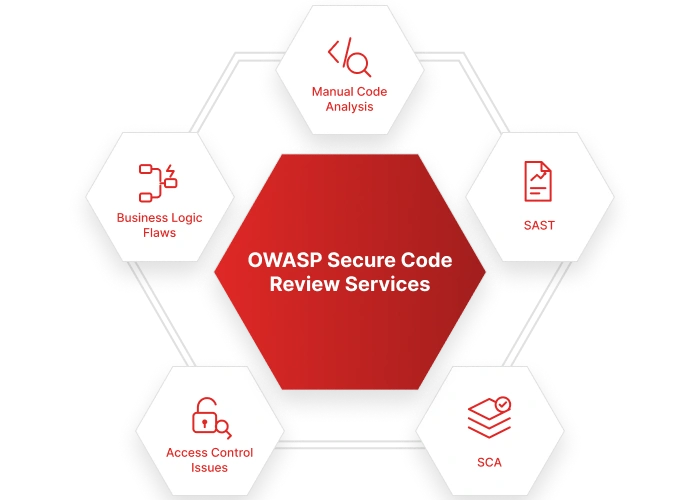
We provide OWASP Secure Code Review Services for Application Security in the US, combining manual source code analysis with SAST and SCA to identify vulnerabilities, access control issues, business logic flaws, insecure coding practices, API risks, and supply chain threats that automated tools may miss.
Why Secure Code Review Matters for US Application Security

The security risks in modern applications continue to grow as development teams rely on APIs, cloud services, third party components, and faster release cycles.
The real challenges begin with the need to:
- Identify vulnerabilities in application source code
- Secure authentication and authorization controls
- Protect sensitive data and critical application flows
- Detect business logic and access control issues
- Manage risks across APIs, dependencies, and software supply chains
Poor code security can lead to serious consequences, such as:
- Exploitable application vulnerabilities
- Unauthorized access to sensitive data
- Authentication and authorization failures
- Business logic abuse
- API security weaknesses
- Compliance and security issues
These risks become particularly important for US organizations that handle sensitive customer, financial, healthcare, or business data.
Our OWASP Secure Code Review Services combine manual source code analysis with SAST and SCA tools where appropriate. We review application logic, data flows, authentication, authorization, APIs, dependencies, and security controls to identify issues that automated tools may miss.
We help organizations detect security weaknesses earlier, strengthen application security, improve secure development practices, and reduce risks before vulnerabilities reach production.
Have more questions?
Contact our support team

OWASP Standards and Security Frameworks for Code Review
Secure code reviews need a defined security baseline to identify more than common coding errors. We evaluate application security controls against relevant OWASP standards and frameworks, identify vulnerabilities at the code level, and provide findings that development teams can act on.
OWASP Top 10:2025
The OWASP Top 10:2025 includes a Risk Focused Perspective on the Major Web Application Security Risks such as Broken Access Control, Security Misconfiguration, Software Supply Chain Failures, Cryptographic Failures, Injection, and Authentication Failures. It is used to identify and prioritize application security risks in code review.
OWASP ASVS 5.0
OWASP ASVS 5.0 offers structured security verification requirements for authentication, session management, access control, validation, cryptography, business logic and API security. When a review calls for more detailed and formal application security verification, we use the applicable ASVS requirements.
OWASP API Security Top 10:2023
OWASP API Security Top 10:2023 looks at the specific security threats to APIs, such as Broken Object-Level Authorization, Broken Authentication, Unrestricted Resource Consumption and Unsafe Consumption of APIs. It's used for evaluating API endpoints, authorization controls, data exposure, and API-specific workflows.
CWE Top 25:2025
CWE Top 25:2025 features common and high-risk software vulnerabilities, including Cross-Site Scripting, SQL Injection, and Missing Authorization. CWE classifications are used to describe the underlying weakness of confirmed findings and give a basis to developers that they can use to remediate the findings.
The applicable framework depends on the application’s architecture, technology stack, API exposure, and review objectives. Using these standards as a baseline helps make the review systematic while allowing our reviewers to examine application-specific logic and risks that generic checklists may not capture.
Secure Code Review Services for Web, API & Application Security
We provide secure code review services, such as baseline application reviews, security-critical component reviews, and development lifecycle integrated reviews. We give findings with exact locations of codes, severity and priority, clear explanations, and remediation advice on how to fix it practically and, if necessary, developer debriefs and remediation support.
Technologies We Use for Secure Code Review
Our OWASP Secure Code Review Services combine manual analysis with security tools to identify application, API, dependency, and code vulnerabilities.
-
SAST Scans source code for vulnerabilities and insecure coding patterns.
-
SCA Identifies vulnerable dependencies, outdated libraries, and supply chain risks.
-
Programming Languages Supports Java, C#, JavaScript, TypeScript, Python, PHP, Go, C, and C++.
-
API Security Reviews REST and GraphQL APIs for authentication, authorization, and data exposure risks.
-
CI/CD and DevSecOps Integrates security checks into development and deployment pipelines.
-
Git and Code Repositories Supports Git, GitHub, GitLab, and Bitbucket based code review workflows.
Security Controls We Assess During Code Review
Security code review needs to examine more than individual vulnerability patterns. We assess how security controls are implemented across the application, including how data enters, moves through, and is protected by the code.
Our review includes:
-
Authentication & session management for login flows, session handling, MFA, and credential controls
-
Authorization & access control for permission checks, privilege boundaries, and unauthorized access paths
-
Input validation & output handling for injection risks, unsafe data processing, and encoding issues
-
Cryptography & secrets for weak algorithms, insecure key handling, hard-coded credentials, and random-number use
-
Data protection for sensitive information exposed through logs, errors, caches, APIs, or overly broad access
-
Error handling & logging for information leakage, insecure exception handling, and inadequate security events
-
Dependencies & configuration for vulnerable components, insecure defaults, and configuration weaknesses
We assess these controls in the context of the application's architecture and business logic, rather than treating each security control as an isolated checklist item. This helps identify weaknesses that depend on how different components and workflows interact.
Compliance-Aligned Secure Code Review
Secure code review can support compliance programmes by providing evidence that application security controls and coding practices have been assessed against relevant requirements. Xcodefix Global maps review findings to applicable security standards where required by the project.
Our approach can support:
-
OWASP ASVS 5.0 for structured application security verification
-
PCI DSS requirements related to secure software development and code review
-
HIPAA security considerations for applications handling protected health information
-
SOC 2 security controls relevant to software development and change management
-
ISO 27001 application security and secure development practices
-
CWE classifications to document and communicate underlying software weaknesses
We document findings with their security impact, applicable framework references, severity, and remediation guidance. This gives development and security teams a clearer record of identified risks while supporting broader security and compliance activities.
How a Secure Code Review Engagement Runs
Scope & Codebase Assessment
We review the application architecture, technology stack, codebase scope, security-critical components, APIs, and review objectives. We define the review depth and applicable OWASP standards before the assessment begins.
Automated Analysis & Review Preparation
Where appropriate, we use SAST and SCA to identify potential code vulnerabilities and dependency risks. We triage the results and use them to focus manual review rather than treating automated findings as final.
Manual Source Code Review
Our reviewers examine source code for authentication and authorization issues, injection, cryptographic weaknesses, business logic flaws, insecure data flows, race conditions, and other application-specific risks.
Finding Validation & Risk Assessment
We validate identified issues in their application context, filter false positives, assess exploitability and impact, and map relevant findings to OWASP Top 10:2025, ASVS 5.0, API Security Top 10:2023, or CWE where applicable.
Reporting & Developer Debrief
We provide findings with precise code locations, severity and priority, security impact, and practical remediation guidance. We then debrief the development team to explain the issues and recommended fixes.
Remediation Support & Verification
We remain available during remediation to clarify findings and help developers address the underlying weaknesses. Where required, we can perform a follow-up review to verify that reported issues have been resolved.
Timelines and Project Realities
The time frame of code reviews varies based on the size of the code base, the complexity of the application, the number of components, and the level of review needed. A security-critical component might take days to review, and a larger application review takes longer. We define the scope of the review according to the code base, architecture, technology stack and assurance requirements before committing to a timeline.
Secure Code Review Use Cases Across US Industries
What a Secure Code Review Helps Identify
A secure code review can help reveal security vulnerabilities that would not be uncovered by external tests. By reviewing source code, you can identify errors in the authorization logic, improper data flows, hard-coded secrets, cryptographic misuse, injection paths, business logic errors, and security breaches caused by changes to the application.
Our reviewers evaluate these issues by considering the architecture of the application, its likely behavior, and validate findings before reporting, and offer practical remediation advice. This enables development teams to mitigate security vulnerabilities before they turn into live issues.
Why Choose Xcodefix Global for OWASP Secure Code Review Services

Software Engineering Expertise
Our reviewers work in software engineering, giving them practical understanding of how production applications, APIs, and back-end systems are built.

Manual-First Security Assessment
We go beyond automated findings to assess application logic, authorization, data flows, and security controls that require code-level understanding.

Application-Specific Findings
We provide precise code locations, security impact, severity, priority, and practical remediation guidance for each validated finding.

Multi-Stack Code Review
We review PHP, JavaScript/TypeScript, Python, Java, C#, and Go across common web, API, and mobile back-end architectures.

Security-Aligned Development Support
We support secure development through CI/CD security controls, SAST, dependency scanning, review gates, and developer security guidance.

Scope Matched to Risk
We tailor the review to the application's architecture, codebase, security-critical components, and required assurance level.
OWASP Secure Code Review Areas We Serve Across the US
We provide OWASP Secure Code Review services to businesses across major US cities and states. Our reviews help teams identify code level security risks and improve application security.
- San Francisco Bay Area
- Seattle
- New York
Ready to Review Your Code Before It Reaches Production?
Identify vulnerabilities that automated scanning may miss through manual source code review aligned with OWASP standards. We assess application logic, access controls, data flows, cryptography, APIs, and other security-critical code areas.
Talk to our secure code review experts to scope a review based on your application, technology stack, and security requirements.
Get a Free Consultation