
Best Healthcare Interoperability Consultant in the US
Build a scalable healthcare data exchange strategy with our interoperability consulting services. We help US healthcare organizations assess data flows, define requirements, design architectures, evaluate standards, and create practical roadmaps.
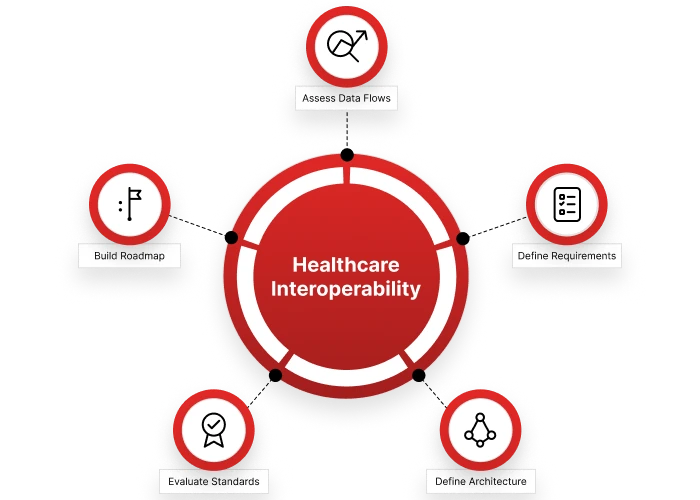
Why Healthcare Interoperability Consulting Matters in the US
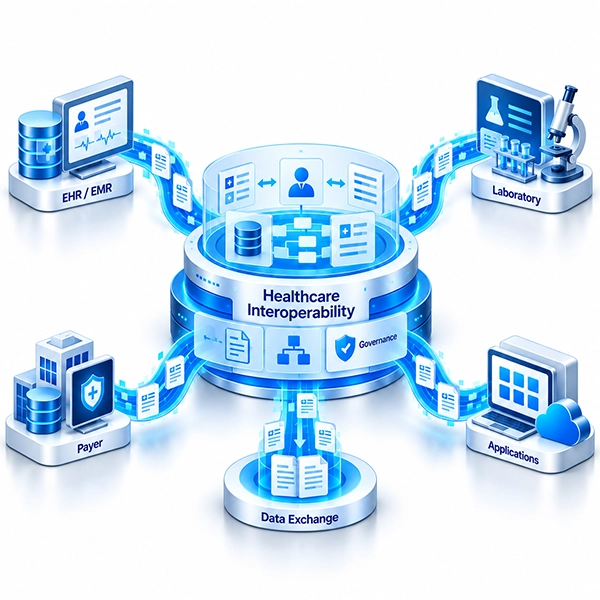
Healthcare organizations need to connect EHRs, EMRs, laboratories, payers, applications, and other systems while maintaining consistent data exchange. Common challenges include:
- Complex data flows
- Multiple healthcare standards
- Patient identity management
- Terminology and data mapping
- Unclear system ownership
- Growing point to point connections
- Changing integration requirements
- Limited interoperability governance
Without a clear integration strategy, healthcare organizations may face:
- Higher integration costs
- Complex point to point architectures
- Duplicate interfaces
- Data synchronization issues
- Inconsistent patient information
- Difficult system maintenance
- Delayed integration projects
- Security and compliance risks
Xcodefix Global provides healthcare interoperability consulting services for US healthcare organizations. We assess your systems, workflows, data standards, regulatory requirements, and integration needs to develop practical architecture options
Our consultants create a prioritized interoperability roadmap covering architecture, standards, dependencies, costs, and governance. Since we also build healthcare interfaces, our recommendations consider real implementation requirements while remaining vendor neutral.
Have more questions?
Contact our support team

US Healthcare Interoperability Architecture & Standards
Healthcare interoperability depends on more than data exchange. We assess how information moves, how systems interpret it, and how teams manage identity, architecture, errors, security, and ongoing changes.

Transport
Defines how healthcare information moves through APIs, messaging, secure file transfer, networks, and other connectivity methods

Syntax
Defines how systems structure and exchange healthcare information using HL7, FHIR, C Cدا, X12, and other formats.

Semantics
Ensures systems understand exchanged information consistently using LOINC, SNOMED CT, ICD, RxNorm, and other terminology.

Governance
Defines ownership for data, patient identity, interfaces, errors, standards, security, changes, and ongoing maintenance.

Hub and Spoke vs Point to Point
Helps determine whether centralized integration or direct connections best fit your systems, data flows, ownership, and growth.

FHIR Server vs FHIR Façade
Determines whether your use case needs persistent FHIR storage or can expose existing data through a FHIR façade.
Canonical Data Models
Create consistent healthcare data representations and help reduce repeated transformations across connected systems.

Patient Identity & Matching
Addresses patient identifiers, demographic data, matching rules, duplicate records, reconciliation, and identity workflows.

Error Handling & Governance
Defines consistent approaches for acknowledgments, retries, monitoring, alerts, replay, escalation, and interface ownership.
| Standard / Framework | Healthcare Interoperability Use |
|---|---|
| HL7 v2.x | ADT, orders, results, scheduling, and clinical messaging |
| FHIR R4 / R4B | Healthcare resources, APIs, and modern data exchange |
| C-CDA | Structured clinical document and healthcare record exchange |
| SMART App Launch | Secure application access to FHIR data |
| X12 / EDI | Claims, eligibility, payment, and administrative transactions |
| IHE Profiles | Healthcare information exchange and workflow interoperability |
| SNOMED CT | Standardized clinical terminology and concepts |
| LOINC | Laboratory and clinical observation terminology |
| ICD 10 / ICD 11 | Diagnosis and healthcare classification |
| RxNorm | Standardized medication terminology |
Our healthcare interoperability consulting services help organizations determine which standards and technologies fit each data exchange requirement instead of forcing every workflow into the same integration model.
Healthcare Interoperability Consulting Services in the US
Healthcare Interoperability Technologies We Support
Healthcare interoperability can use different technologies to connect systems, exchange data, automate workflows, and support secure integration. We select the appropriate technology based on your architecture and requirements.
- REST APIs connect healthcare applications, platforms, and external systems through application based data exchange.
- Mirth Connect routes, transforms, validates, monitors, and manages healthcare messages between connected systems.
- SFTP supports secure file based healthcare data exchange for systems that require scheduled or batch transfers.
- Webhooks support event based communication between connected applications and platforms.
- JDBC / SQL supports approved database connectivity, data access, and reporting requirements.
- SOAP supports integration with compatible legacy healthcare applications and services.
- OAuth 2.0 supports secure authorization for APIs and connected healthcare applications.
- Cloud Platforms support scalable healthcare integration environments, API services, interface infrastructure, monitoring, and deployment.
We evaluate these technologies based on your existing systems, data flows, security requirements, performance needs, and long term maintenance requirements.
Healthcare Interoperability Compliance for US Organizations
Interoperability increasingly involves regulatory requirements that affect APIs, information exchange, patient access, and healthcare data sharing. For US healthcare organizations, we consider applicable requirements and programs such as:
- HIPAA for privacy, security, and protected health information.
- 21st Century Cures Act and information blocking requirements for health information access and exchange.
- ONC interoperability requirements affecting certified health IT and standardized API access.
- CMS interoperability requirements affecting applicable payer and patient access workflows.
- TEFCA for participation in nationwide health information exchange networks.
We map applicable requirements to your data flows, architecture, security controls, APIs, identity processes, and governance model. Regulatory requirements can change, so our consulting provides technical and strategic guidance rather than legal advice.
How Our Healthcare Interoperability Consulting Works
Discovery & Requirements
Review your systems, workflows, data flows, stakeholders, standards, regulatory requirements, and existing integration environment.
Current State Assessment
Document existing interfaces, APIs, data formats, transports, dependencies, ownership, security requirements, and interoperability gaps.
Architecture & Standards Strategy
Evaluate integration patterns, FHIR options, HL7 requirements, implementation guides, terminology, identity, security, and governance requirements.
Options & Recommendations
Develop practical architecture options with clear trade offs, costs, dependencies, risks, priorities, and implementation considerations
Roadmap & Governance
Create a sequenced roadmap with implementation phases, resource requirements, ownership, standards decisions, vendor responsibilities, and governance processes.
Implementation Support
Support your internal team or implementation partner with architecture reviews, technical guidance, standards decisions, vendor coordination, and implementation oversight.
Healthcare Interoperability Project Timelines
An interoperability assessment project that is conducted in a concentrated fashion for a mid-size organization usually takes 3-6 weeks from kick-off to roadmap.
Phase one is normally about discovery, interviews, evidence collection, systems inventory, and the as-is assessment. Phase two is about architecture, standards assessment, options, roadmap creation, costing, dependencies, and governance. Programs for large organizations with multiple entities can take longer. The duration will depend on the number of systems, facilities, interfaces, people, data flows, documents, and architecture involved. We assess these factors before defining the engagement scope and timeline.
Healthcare Interoperability Organizations We Support in US
How Xcodefix Global Solves Healthcare Interoperability Challenges
Healthcare organizations may have multiple EHRs, laboratories, APIs, interface engines, and legacy systems that do not exchange data efficiently.
For example, a hospital may need to connect its EHR with a laboratory, HIE, payer, and patient app. Xcodefix Global maps these systems, identifies data flows and ownership, evaluates HL7 and FHIR options, and recommends the right architecture.
We then provide practical priorities, costs, dependencies, and implementation steps while avoiding unnecessary interfaces and technology.
Why Xcodefix Global for Healthcare Interoperability Consulting

Healthcare Integration Expertise
We understand healthcare data exchange, clinical workflows, EHRs, EMRs, laboratories, payers, HIEs, APIs, interface engines, and healthcare applications.

Standards & Architecture Expertise
We work across HL7, FHIR, C-CDA, X12, IHE, DICOM, NCPDP, SMART on FHIR, OAuth 2.0, and healthcare terminology standards.

Vendor Neutral Advice
Our recommendations remain execution neutral. We document the assumptions, architecture options, trade offs, and technical reasoning so your organization can use the roadmap with any capable implementation partner.

Practical Implementation Experience
Our healthcare integration team builds and operates interfaces, so we understand the practical impact of architecture decisions on development, testing, deployment, monitoring, and maintenance.

Costed & Sequenced Roadmaps
We do not stop at recommendations. We define priorities, dependencies, budget ranges, implementation phases, risks, and governance requirements.

Flexible Engagement Models
We provide fixed price assessments and architecture engagements for defined scopes. We also support monthly consulting and fractional interoperability leadership for organizations that need continuing guidance.
Healthcare Interoperability Consulting Across the US
We provide healthcare interoperability consulting services for hospitals, health systems, laboratories, payers, HIEs, medical groups, healthcare technology companies, and digital health organizations across the United States.
- Nashville
- Minneapolis-Eden Prairie
- Indianapolis
- Los Angeles
Need a Defensible Healthcare Interoperability Plan?
Tell us where you are in your interoperability journey. Whether you are connecting EHRs, evaluating FHIR, replacing legacy interfaces, or planning HIE connectivity, our consultants can assess your environment and create a practical architecture and implementation roadmap.
Get a Free Consultation