
VAPT & Cybersecurity Penetration Testing Services in the US
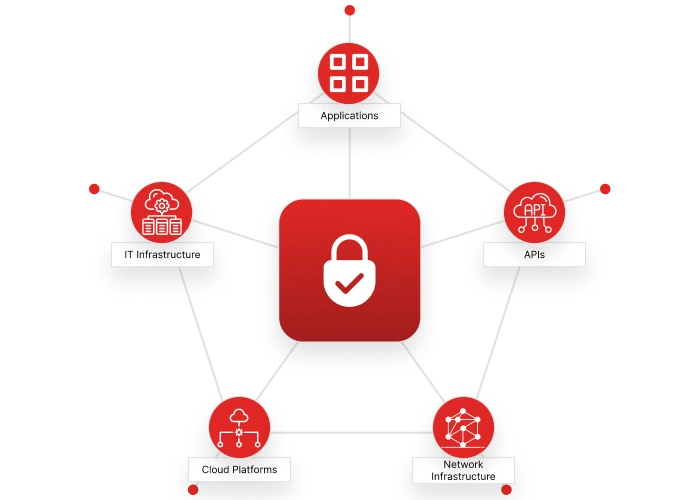
Our company performs Vulnerability Assessment & Penetration Testing (VAPT) testing for US-based clients, which allows us to discover vulnerabilities in applications, APIs, network infrastructures, cloud platforms, and IT infrastructures. We perform VAPT testing in an automated and manual way.
Why VAPT & Penetration Testing Matters for US Companies
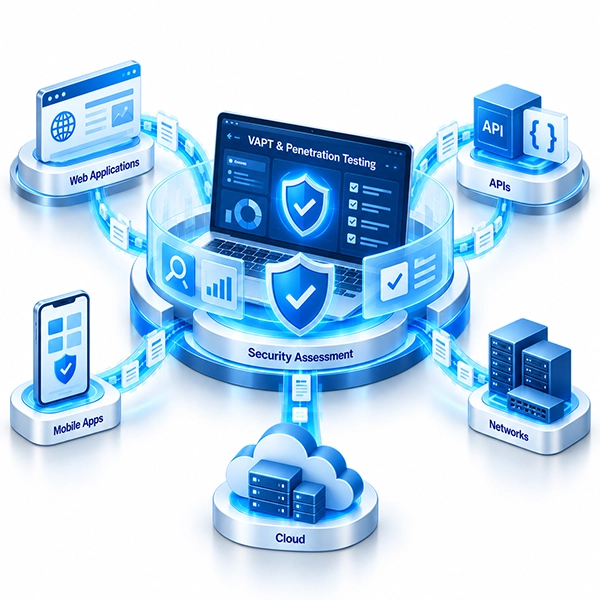
US companies rely on web applications, APIs, mobile applications, cloud platforms, networks, and connected systems for daily operations. Common security challenges include:
- Insecure configurations
- Outdated software components
- Weak authentication
- Improper access controls
- Application vulnerabilities
- Complex interconnected systems
- Limited visibility into exploitable weaknesses
Basic vulnerability scans can identify known security issues, but they may not detect vulnerabilities that require manual testing, business logic analysis, or attack simulation. Attackers can combine multiple weaknesses to:
- Gain unauthorized access
- Expose sensitive data
- Bypass security controls
- Move across connected systems
- Disrupt business operations
- Increase security and compliance risks
We offer VAPT and penetration testing services for US companies. Our approach combines vulnerability assessment, automated scanning, manual testing, validation, analysis, and remediation guidance.
We test realistic attack surfaces to identify vulnerabilities that attackers are most likely to exploit. Our reports provide clear findings with severity, evidence, business impact, affected assets, and practical remediation recommendations.
Have more questions?
Contact our support team

VAPT & Penetration Testing Standards
Companies make use of different security assessment and testing frameworks to discover any security vulnerabilities within their applications, APIs, networks, cloud computing, and infrastructure. These frameworks are meant for certain purposes, and knowing how they work will help companies assess security effectively.

OWASP Web Application Security
OWASP Top 10 is the popular security testing framework that allows you to find security issues related to web applications such as access control, injections, misconfigurations of security measures, authentication, and other vulnerabilities of the component.

OWASP API Security
OWASP API Security Top 10 is a framework that covers security risks of an API, namely broken object level authorization, broken authentication, resource consumption, overexposure of the data, and others..

NIST Security Testing
NIST security testing guidance provides structured approaches for assessing information systems, identifying vulnerabilities, validating security controls, and supporting risk based security testing.
| Feature | OWASP Top 10 | OWASP API Security | NIST Security Testing |
|---|---|---|---|
| Primary Focus | Web application security | API security | Information system security |
| Testing Scope | Applications and web services | APIs and application interfaces | Applications, systems, networks, and infrastructure |
| Primary Strength | Common web application risks | API specific vulnerabilities | Structured security assessment |
| Common Challenge | Application specific implementation | Complex API authorization and business logic | Broad assessment requirements |
| Typical Use | Web application VAPT | API penetration testing | Enterprise security assessments |
Organizations can use these standards together to build a comprehensive VAPT and penetration testing approach. OWASP helps identify application and API risks, while NIST guidance supports broader security assessment and risk management. This combination helps organizations identify vulnerabilities, validate security controls, and prioritize remediation across their technology environment.
Our VAPT & Penetration Testing Services in the US
VAPT Testing Methodology
Successful security assessment requires not only running an automated scan. Our approach combines the discovery of vulnerabilities, manual security testing, risk analysis and remediation recommendations in order to detect real world exploitable security gaps
- Scope & Asset Discovery to identify the applications, APIs, networks, cloud environments, systems and boundaries of testing.
- Automated Vulnerability Assessment to find vulnerabilities, old versions of software, open services and misconfigured settings.
- Manual Security Testing to perform an analysis of authentication, authorization, business logic, input validation, session handling, APIs and privilege escalation.
- Vulnerability Validation to validate findings, gather evidence and evaluate their potential security impact.
- Risk Analysis & Reporting to categorize vulnerabilities in terms of severity, exploitability, affected systems and business impact.
- Remediation & Retesting to give recommendations and ensure that the detected vulnerabilities have been fixed.
Our approach is a blend of automated tools and manual security testing, enabling us to detect both known vulnerabilities and the ones specific to your application.
Vulnerability Severity & Risk Prioritization
Not every vulnerability creates the same level of risk. We help organizations prioritize security issues based on their potential impact and exploitability.
Critical Vulnerabilities : These vulnerabilities may allow attackers to gain significant unauthorized access, execute commands, compromise sensitive systems, or access critical data.
High Risk Vulnerabilities : These issues can provide substantial unauthorized access, privilege escalation, sensitive data exposure, or other serious security impact.
Medium Risk Vulnerabilities : These weaknesses may require specific conditions or additional access but can still increase the attack surface and security risk.
Low Risk Vulnerabilities : These findings generally have limited direct impact but may contribute to a broader attack path when combined with other weaknesses.
How a VAPT Engagement Runs
Scope & Security Assessment Planning
We understand your applications, APIs, infrastructure, testing objectives, business requirements, and authorized testing boundaries. We define the scope, testing approach, assets, credentials, and rules of engagement.
Reconnaissance & Asset Discovery
We identify in scope assets, technologies, endpoints, services, application components, and exposed attack surfaces. This helps us understand how the environment could appear to an external or internal attacker.
Automated Vulnerability Assessment
We use security testing tools to identify known vulnerabilities, outdated components, configuration issues, exposed services, and other potential weaknesses.
Manual Penetration Testing
Our security testers manually validate findings and test authentication, authorization, business logic, input validation, session management, APIs, privilege escalation, and other attack paths.
Vulnerability Validation & Risk Analysis
We validate identified vulnerabilities in a controlled manner and determine their potential impact. We prioritize findings based on severity, exploitability, affected assets, and business impact.
Reporting & Remediation Guidance
We provide a detailed security report covering vulnerabilities, affected assets, evidence, severity, business impact, and recommended remediation actions. We also provide an executive summary for management teams.
Retesting & Closure
After remediation, we retest identified vulnerabilities to confirm that the fixes work as expected. We update the findings and provide final validation results.
Timelines and Project Realities
A focused VAPT assessment typically takes 1 to 2 weeks, depending on the number of applications, APIs, systems, and testing requirements. Larger assessments covering networks, cloud environments, or multiple business applications can take several weeks. We define the scope and expected timeline upfront based on the testing environment, access requirements, and project complexity.
VAPT & Penetration Testing Use Cases for US Companies
A Real World VAPT Example
A business organization needed to assess the security of its customer facing web application and supporting APIs before a major product launch. We have already run an automated vulnerability scan and didn't find any high severity vulnerabilities. We performed our own penetration test on application's authentication, authorization, API endpoints and work flow. During testing we found an authorization issue and an authenticated less privileged user was able to access some sensitive data linked to another account by tweaking an object id in an API request.
We confirmed it by testing it in a controlled environment and described the vulnerable endpoint and severity and provided recommendations. We tested it again after the development team fixed it and found it could not be achieved any more.
Why Xcodefix Global for VAPT & Penetration Testing Services

Security Testing Expertise
We combine vulnerability assessment, penetration testing, manual validation, and security analysis to identify practical risks across applications, APIs, networks, and infrastructure.

End to End Security Assessment
We support the complete testing lifecycle from scope definition and reconnaissance to reporting, remediation guidance, and retesting.

Manual & Automated Testing
We combine automated vulnerability scanning with manual testing to identify vulnerabilities that automated tools may not detect.

Risk Based Reporting
We provide clear findings with severity, evidence, business impact, and practical remediation recommendations to help teams prioritize security improvements.

Technology Focused Testing
Our team can assess web applications, APIs, mobile applications, networks, cloud environments, servers, databases, and enterprise infrastructure.

Scalable Security Services
We support individual application assessments as well as broader security testing programs based on your environment, technology stack, and security objectives.
Nationwide VAPT & Penetration Testing Services Across the US
We provide VAPT services, penetration testing services, and cybersecurity testing solutions for businesses, technology companies, healthcare organizations, financial services companies, SaaS providers, and enterprises across the United States.
- Washington DC / Northern Virginia
- New York
- Los Angeles
- Dallas-Fort Worth
- San Francisco Bay Area
Secure Your Business with VAPT Services in the US
Identify vulnerabilities before attackers can exploit them with comprehensive VAPT and penetration testing services in the US. Our team can assess your applications, APIs, networks, cloud environments, and IT infrastructure and provide clear remediation guidance.
Talk to our US security testing experts today and strengthen your security posture with Xcodefix Global.
Get a Free Consultation