
Best Security Awareness Training for Businesses in the US
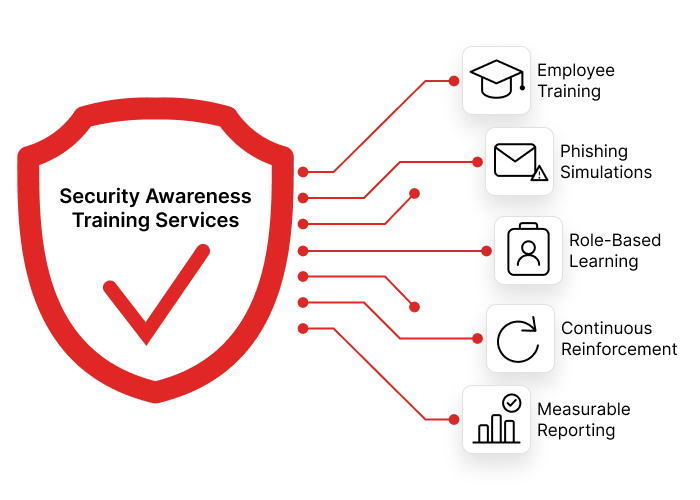
We provide security awareness training services that help organizations reduce human cyber risk and build a workforce that can recognize, resist, and report real-world threats. Our cybersecurity awareness training combines employee training, phishing simulations, role-based learning, continuous reinforcement, and measurable reporting to strengthen security behaviour.
Why Security Awareness Training Programs Fail & How We Solve Them

Employees remain common targets for phishing, business email compromise, social engineering, and impersonation attacks. Common training challenges include:
- Annual training with limited reinforcement
- Generic content that does not match employee roles
- Low employee engagement
- Limited phishing simulation
- Poor visibility into human security risks
- Employees forgetting training content over time
Weak security awareness can increase the risk of:
- Phishing attacks
- Business email compromise
- Credential theft
- Unauthorized account access
- Fake payment requests
- Social engineering attacks
- Data breaches
- Supply chain security incidents
How Xcodefix Global Helps
Xcodefix Global provides security awareness training services designed around real world threats and employee roles. We combine targeted learning, realistic phishing simulations, role based training, and ongoing reinforcement to keep security awareness active throughout the year.
Our approach helps organizations identify high risk behaviors, improve phishing reporting, and reduce human related security risks across teams.
Have more questions?
Contact our support team

Security Awareness Training Standards and Frameworks
A strong security awareness program should align with recognized security frameworks, regulatory requirements, and organizational policies. We structure training around established security practices while adapting the content to each organization’s workforce, technology environment, and risk profile.

NIST Cybersecurity Framework
Security awareness training can align with the NIST Cybersecurity Framework by helping employees understand their role in identifying, protecting against, detecting, and responding to security threats.

HIPAA Security Awareness
For healthcare organizations, training can address employee responsibilities related to protecting Protected Health Information (PHI). Topics can include phishing, password security, access control, data protection, and secure handling of sensitive information.

ISO 27001 Awareness
Training can support ISO 27001 security awareness requirements by helping employees understand information security policies, responsibilities, acceptable use, incident reporting, and secure working practices.

SOC 2 Security Awareness
Security awareness programs can support SOC 2 controls by reinforcing secure employee behavior, access management practices, data protection, and security incident reporting.

Security Awareness Program Integration
We can integrate security awareness activities with existing security policies, risk management programs, compliance processes, and security operations. This approach helps organizations maintain consistent security practices across employees, systems, and business functions.
Security Awareness Training Services for US Businesses
Whether you need a structured security awareness training program, phishing simulation training, or ongoing managed support, our approach can be adapted to your organization’s workforce, risk profile, and compliance requirements.
Human Risk Assessment & Security Awareness Metrics
Security awareness measurement should show whether training is changing employee behaviour, not only whether employees completed their courses. We establish a baseline and use defined measures to understand how human cyber risk changes throughout the program.
-
Phishing susceptibility: Shows how employees respond to simulated phishing scenarios and where greater exposure exists.
-
Phishing click rate: Indicates how often employees interact with simulated malicious content and helps identify recurring risk patterns.
-
Phishing report rate: Shows whether employees recognize and report suspicious messages, providing a useful security awareness indicator.
-
Training engagement: Highlights participation and engagement patterns that may affect the effectiveness of ongoing awareness activities.
-
Role-level risk trends: Helps identify whether particular teams or roles require more targeted training or reinforcement.
Comparing these measures across campaigns provides a clearer view of security awareness program effectiveness and helps organizations focus training where human cyber risk is highest.
Security Awareness Program Delivery
Security awareness training works best when it is based on the ways employees work and the type of threats they might face. Programs are organised around real life learning, realistic scenarios and frequent review as opposed to a one-off annual event.
Our approach includes:
-
Short, role-relevant training focused on practical security behaviours
-
Realistic phishing simulations matched to common attacker techniques and organizational context
-
Just-in-time guidance after simulated phishing interactions
-
Role-based learning for finance, executives, developers, IT, helpdesk, and general staff
-
Continuous reinforcement through brief, regular awareness activities
-
Reporting mechanisms that encourage employees to flag suspicious activity early
Programs can be delivered as an end-to-end managed service or alongside an organization's existing security team, depending on its internal resources and requirements.
Security Awareness Compliance & Audit Evidence
Security awareness training can form part of an organization's broader compliance program. Training and documentation align with applicable requirements and internal policies but not a one-size-fits-all compliance approach.
Our programs can support:
-
HIPAA security awareness training for organizations handling protected health information
-
ISO 27001 and SOC 2 awareness and training requirements where applicable
-
Training completion records for audit and compliance reviews
-
Policy acknowledgement records tied to organizational security policies
-
Phishing simulation results and awareness metrics as supporting evidence
-
Documented training activities that help demonstrate ongoing security awareness efforts
This connects employee training with the organization's wider security and compliance program, giving security teams both practical behaviour-change data and records they can use during reviews.
How a Security Awareness Training Engagement Runs
Assess Current Awareness and Risk
We establish a baseline using an initial phishing simulation and, where useful, a knowledge assessment. This helps identify existing awareness gaps, phishing susceptibility, and areas of higher employee cyber risk.
Design the Training Program
We define the training scope, learning cadence, role-based content, phishing simulation approach, and reporting measures based on the organization's workforce, policies, and risk profile.
Deliver Core and Role-Based Training
Employees receive focused security awareness training covering common threats and everyday security practices. Additional modules address risks specific to finance, executives, developers, IT, helpdesk, and other roles.
Run Phishing Simulations and Reinforcement
Realistic simulations provide practical testing of security awareness. Employees who interact with a simulated threat receive immediate guidance, while regular reinforcement keeps key behaviours relevant over time.
Measure Behaviour and Report Results
We review campaign results against the initial baseline to identify changes in employee behaviour, areas of improvement, and risks requiring further attention.
Refine and Continue the Program
Training content and simulation campaigns are adjusted based on results, emerging threats, and changes in organizational risk. This creates an ongoing security awareness program rather than a one-time training exercise.
Timelines and Program Considerations
Security awareness programs are implemented in various phases depending on the size of the workforce, the range of training required, their duties and how often they are simulated. Training, phishing simulations, reinforcement and continual measurement follow initial assessment and program setup. The schedule is intended to keep staff regularly aware but not causing undue disruption to staff.
Security Awareness Training Use Cases for US Businesses
A Practical Security Awareness Training Example
A typical program may begin with a baseline phishing simulation to understand how employees respond to common attack scenarios. Results help identify higher-risk teams and guide subsequent training. Finance employees may focus on BEC, invoice fraud, and payment verification, while IT and helpdesk teams address social engineering and account-reset requests.
Employees who interact with simulated phishing messages receive immediate guidance on the warning signs they missed. Follow-up simulations and reinforcement activities track phishing susceptibility, click rates, and report rates over time, giving security teams a clearer view of behaviour change and areas needing further attention.
Why Choose Xcodefix Global for Security Awareness Training

Continuous Role-Based Training
We combine focused learning, role-specific content, phishing simulations, and regular reinforcement instead of relying on annual training.

Realistic Phishing Simulation Campaigns
Campaigns use relevant phishing lures and difficulty levels to test recognition while providing immediate guidance after simulated interactions.

Risk-Specific Employee Training
Finance, executives, developers, IT, helpdesk, and general staff receive training focused on threats relevant to their roles.

Security Reporting Measurement
We encourage employees to report suspicious activity and track report rates as an important indicator of security awareness.

Human Risk Measurement
We assess phishing susceptibility, click and report rates, engagement, and team-level trends to identify where additional training is needed.

Compliance-Ready Training Evidence
We maintain completion records, policy acknowledgements, and simulation results that support applicable HIPAA, ISO 27001, and SOC 2 requirements.
Areas We Serve With Security Awareness Training Across the US
We provide security awareness training for businesses across the US, helping employees recognize threats, follow secure practices, and reduce cybersecurity risks.
- Austin
- Columbus
Ready to Strengthen Your Security Awareness Program?
Reduce employee cyber risk with security awareness training services, phishing simulations, role-based training, and continuous security reinforcement. Whether you need to establish a new awareness program, improve an existing one, or support ongoing compliance requirements, our team can help.
Talk to our security awareness experts today and build a measurable, practical security awareness program with Xcodefix Global.
Get a Free Consultation