
Best Threat Intelligence & Incident Response Services in US
Protecting EHRs, EMRs, medical devices, health portals, digital health platforms, and sensitive PHI and PII requires proactive cybersecurity. Our threat intelligence and incident response services cover threat hunting, malware analysis, digital forensics, incident containment, and HIPAA aligned security.
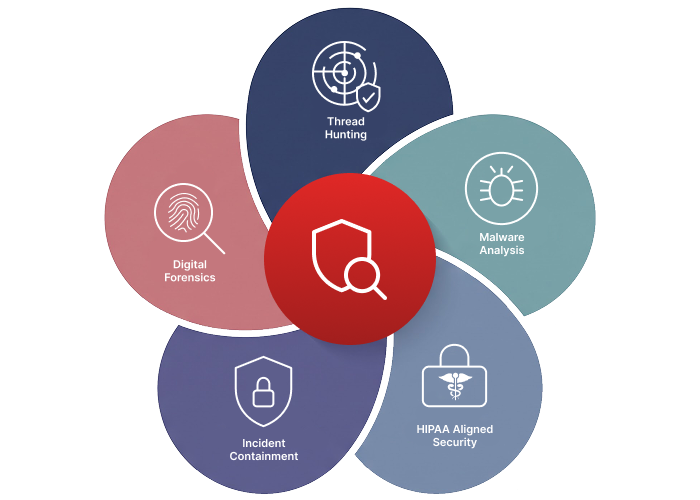
Why US Healthcare Cybersecurity Fails and How We Help
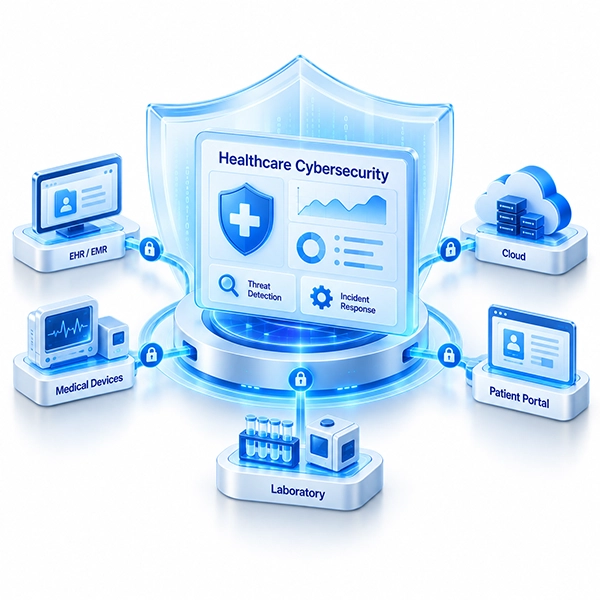
US healthcare organizations manage EHRs, EMRs, medical devices, laboratories, cloud services, patient portals, and other connected systems. This creates a complex security environment.
Common challenges include:
- Outdated healthcare systems
- Limited security visibility
- Increasing attack surfaces
- Weak threat detection
- Ineffective incident response procedures
- Complex connected healthcare environments
- Risks to PHI, PII, and sensitive healthcare data
Weak security strategies and inefficient response processes can increase the impact of:
- Ransomware attacks
- Malware infections
- Phishing attacks
- Credential based attacks
- Unauthorized system access
- Data breaches
- Clinical and operational disruptions
- HIPAA compliance risks
Xcodefix Global helps US healthcare organizations strengthen cybersecurity through threat intelligence and incident response services. We support threat detection, investigation, threat hunting, containment, digital forensics, and recovery.
Our US healthcare cybersecurity services help organizations identify threats earlier, respond to incidents faster, protect sensitive healthcare data, and improve security operations while supporting HIPAA compliance requirements.
Have more questions?
Contact our support team

US Healthcare Threat Intelligence & Response Frameworks
Healthcare organizations need both proactive threat intelligence and structured incident response. Threat intelligence helps security teams understand potential threats before they affect clinical systems. Incident response provides a defined process when suspicious activity or a confirmed security incident occurs.

Threat Intelligence
Threat intelligence provides context about cyber threats that may affect healthcare organizations. We analyze threat actors, indicators of compromise, vulnerabilities, malware activity, attack techniques, and emerging threats.

Incident Response
Incident response provides a structured approach for managing cybersecurity incidents. It covers preparation, detection, investigation, containment, eradication, recovery, and post incident improvement..

Digital Forensics & Malware Analysis
Digital forensics and malware analysis help determine what happened during a security incident. We examine endpoint artifacts, system logs, network activity, suspicious files, and malicious processes to establish the scope and attack path.
| Feature | Threat Intelligence | Incident Response |
|---|---|---|
| Operational Model | Proactive threat monitoring and analysis | Structured response to active incidents |
| Primary Focus | Identifying threats, vulnerabilities, and attacker behavior | Containing incidents and restoring affected systems |
| Common Challenge | Managing large volumes of threat information | Coordinating response across complex healthcare environments |
| Typical Use | Threat hunting, vulnerability prioritization, and detection improvement | Ransomware response, forensic investigation, and recovery |
Most US healthcare organizations benefit from both capabilities. Threat intelligence helps teams understand and prioritize potential threats. Incident response helps them act quickly when an attack occurs. Connecting intelligence with response processes creates a stronger healthcare security program.
Threat Intelligence & Incident Response Services for US Hospitals
US Healthcare Security Frameworks: NIST, HIPAA & MITRE
Healthcare security requires structured frameworks that connect security activities with measurable objectives. We use recognized cybersecurity frameworks to support threat analysis, incident response, detection, and security improvement.
- NIST Cybersecurity Framework (CSF) for identifying, protecting, detecting, responding to, and recovering from cybersecurity risks.
- HIPAA Security Rule & HITECH for protecting electronic protected health information and supporting healthcare security requirements, including appropriate safeguards for sensitive personal information.
- MITRE ATT&CK for analyzing adversary tactics, techniques, and procedures and improving threat hunting and detection.
- CIS Controls for prioritizing technical safeguards and strengthening defensive security capabilities.
We maintain security and threat intelligence mappings in documented and reviewable processes. This helps security teams validate controls, improve detection coverage, and trace remediation activities during security reviews.
Healthcare Network Security Architecture Services in the USA
Healthcare networks process sensitive patient information and connect clinical systems, medical devices, applications, and cloud environments. Security architecture must protect these environments while maintaining access to critical clinical workflows.
Our approach includes:
- Zero Trust Architecture to verify users and devices before granting access to protected healthcare resources.
- Network Segmentation to separate medical devices, EHR systems, clinical applications, and general enterprise traffic.
- Encryption at Rest and in Transit to protect sensitive healthcare information while stored and exchanged.
- Endpoint Detection and Response across workstations, servers, and supported connected devices.
- Security Logging and Monitoring to track security events, administrative activity, and unusual access patterns.
- Network Security Controls including firewalls, intrusion detection, and other traffic monitoring technologies.
- Identity and Access Management with multi factor authentication, role based access, and least privilege controls.
We also support secure security operations across client managed infrastructure and monitored cloud environments. Our approach can work with existing healthcare security architectures and technology environments.
Healthcare Cybersecurity Compliance Services in the USA
Healthcare organizations that process PHI must protect patient information and maintain appropriate security processes. Xcodefix Global helps US healthcare organizations align cybersecurity operations with applicable compliance requirements.
- HIPAA Security and Privacy Rules for protecting the confidentiality, integrity, and availability of PHI and supporting appropriate safeguards for sensitive patient information.
- HITECH Act Requirements for strengthening healthcare data protection and supporting breach related obligations.
- OCR Guidelines for security risk assessments, breach response, and healthcare privacy requirements.
- Documented Incident Response Plans with defined investigation, containment, recovery, and reporting procedures.
- Access Governance and Audit Trails to support security monitoring and regulatory reviews.
- PII Protection for reducing unauthorized access, exposure, and misuse of personally identifiable information across healthcare applications, systems, and data environments.
- BAA Requirements where our services involve access to protected healthcare information.
We help organizations connect technical security controls with their broader compliance programs. This allows threat detection, incident response, evidence handling, and regulatory processes to work together.
How Our US Healthcare Cyber Defense Engagement Works
Discovery and Asset Profiling
We inventory clinical systems, connected devices, applications, security tools, and data flows. We identify security gaps and visibility limitations across the healthcare environment.
Architecture and Playbook Design
We design threat intelligence workflows, security monitoring processes, and incident response playbooks. We also define escalation paths, containment procedures, and security controls.
Build and Simulation Testing
We configure monitoring workflows, threat detection rules, intelligence feeds, and response processes. We test these capabilities against realistic security scenarios.
Validation and Integration
We validate alert pipelines, investigation workflows, escalation procedures, and containment processes. We also test integration with existing security and clinical environments.
Go Live and Hypercare
We support the transition into active security operations. Our team monitors the environment closely and tunes alerts and response workflows during the initial period.
Ongoing Monitoring and Threat Hunting
We provide ongoing security monitoring, threat intelligence analysis, threat hunting, and incident response support. We also help improve detection and response processes as threats evolve.
US Healthcare Cybersecurity Project Timelines
A focused healthcare security assessment typically takes 2 to 4 weeks. A comprehensive threat intelligence and incident response implementation usually takes 2 to 3 months. Larger healthcare security programs can take longer, and we define the expected timeline during discovery.
The main schedule risks often involve legacy system access, security tool integration, available logs, and internal stakeholder availability. Our discovery process identifies these dependencies early so the project can move forward with fewer delays.
US Healthcare Threat Intelligence & Response Use Cases
Real World US Healthcare Threat Response Example
A regional healthcare organization detected unusual outbound network activity from a legacy clinical system. The security team could not determine whether the activity represented normal communication or a potential compromise.
Our team reviewed network activity, endpoint information, authentication records, and available threat intelligence. We identified indicators that required further investigation and isolated the affected environment while the investigation continued
The forensic review identified suspicious credential activity associated with an exposed application account. We traced related activity across the environment and identified systems that required additional validation, including systems containing sensitive PHI and PII.
We supported containment and secured the affected credentials. We also strengthened network segmentation around the legacy clinical environment and improved monitoring for related indicators.
The investigation helped the organization understand the attack path before the activity could spread further. It also provided security improvements that strengthened monitoring and incident response for future threats.
Why Choose Xcodefix for US Healthcare Cybersecurity

Healthcare Security Expertise
Specialized knowledge of EHRs, medical devices, clinical systems, and digital health platforms helps protect complex healthcare environments.

Rapid Incident Investigation
Quick investigation of suspicious activity helps identify affected systems, trace attacker behavior, and support faster incident containment.

Actionable Threat Intelligence
Relevant threat intelligence turns emerging threats and attacker behavior into practical insights for stronger detection and smarter security decisions.

PHI and PII Protection
Strong access controls, monitoring, and segmentation help protect PHI, PII, credentials, and other sensitive healthcare information from exposure.

Environment Based Security
Security strategies align with clinical workflows, legacy systems, medical devices, cloud platforms, applications, and existing security infrastructure.

Ongoing Security Support
Continuous support helps address root causes, improve security controls, refine response processes, and strengthen readiness for future threats.
Healthcare Cybersecurity Services Across the US
We provide threat intelligence services, incident response services, and healthcare cybersecurity solutions for hospitals, health systems, laboratories, healthcare software vendors, digital health companies, and other healthcare organizations across the United States.
- Washington DC / Northern Virginia
- Baltimore / Fort Meade
Ready to Strengthen Your US Healthcare Cybersecurity?
Protect your EHRs, EMRs, medical devices, healthcare applications, and sensitive PHI and PII with threat intelligence services and incident response services. Whether you need proactive threat hunting, active incident response, or ongoing security support, our team is ready to help.
Talk to our healthcare cybersecurity experts today and build a secure, scalable, and HIPAA aligned security solution with Xcodefix Global.
Get a Free Consultation