
Best Mirth Connect Development & Support Services in US
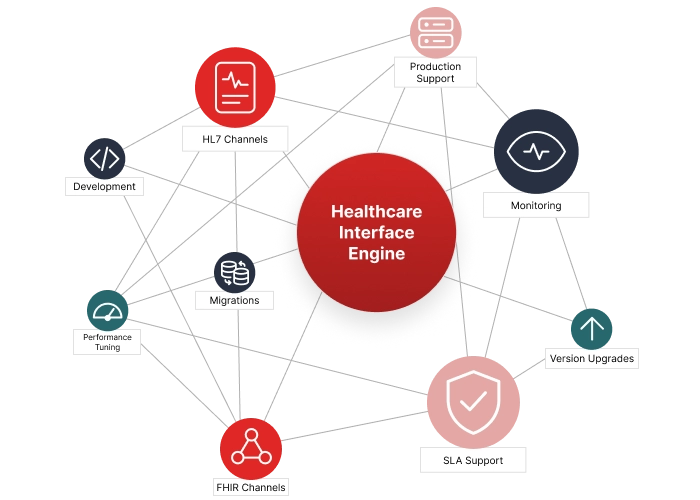
Keep your healthcare interfaces reliable with expert Mirth Connect development and support. From new HL7 and FHIR channels to version upgrades, performance tuning, monitoring, and SLA backed production support, we manage your integration environment from development to production
Why Mirth Connect Expertise Matters for US Healthcare
US healthcare organizations can face challenges when managing Mirth Connect environments, including:
- Legacy integration channels
- Outdated or unsupported configurations
- Complex HL7 transformers
- Undocumented interface workflows
- Growing message queues
- Integration errors and failed messages
- Limited monitoring and visibility
Poorly managed integration environments can lead to:
- Delayed healthcare data exchange
- Failed HL7 messages
- Disrupted clinical workflows
- Data synchronization issues
- Performance problems
- Higher maintenance effort
- Security and compliance risks
Xcodefix Global provides Mirth Connect development and support services for US healthcare organizations. We help organizations build, maintain, troubleshoot, optimize, and support their integration environments.
Our healthcare integration engineers handle HL7 and FHIR channel development, interface audits, troubleshooting, performance tuning, monitoring, upgrades, and SLA backed production support. We help keep healthcare data exchange secure, reliable, and efficient.
Have more questions?
Contact our support team

Mirth Connect: What It Actually Does in Healthcare Integration
Mirth Connect
Mirth Connect is a healthcare integration engine that connects systems which use different data formats and communication methods. It receives data, transforms it when needed, applies routing rules, and delivers it securely to the right destination.
Mirth Connect channels
Mirth Connect channels manage the complete workflow for an interface. For example, an ADT message can update patient demographics across systems, an ORM message can send an order to a laboratory, and an ORU message can return test results to an EHR.
Mirth Connect connectors
Mirth Connect connectors support common healthcare connectivity methods, including HL7 LLP, TCP/IP, REST APIs, SOAP, databases, SFTP, and file-based exchange. They make it possible to connect EHRs, EMRs, LIS, RIS, PACS, billing systems, and digital health applications.
Most healthcare organizations use Mirth Connect as the integration layer between clinical and administrative systems. It does not replace existing software; it enables those systems to exchange accurate information reliably.
Successful Mirth Connect implementation requires correct mapping, secure connectivity, error handling, monitoring, and continuous support. Our Mirth Connect development and support services help organizations build and maintain reliable production interfaces.
Mirth Connect Services We Deliver for US HEalthcare Facilities
Whether you need new interface development, legacy-channel optimization, a secure upgrade, or ongoing production support, our Mirth Connect experts help keep your healthcare data flowing reliably, securely, and at scale.
Mirth Connect Technologies We Support
Mirth Connect sits between healthcare systems, so the right combination of versions, protocols, connectors, and EHR technologies matters. We work across the technologies commonly used to build and maintain healthcare integration environments:
Mirth Connect and compatible integration engines including Mirth Connect, Brigelink, and Open Integration Engine.
Healthcare standards including HL7 v2.x, FHIR R4, STU3, HL7 v3, CDA, C-CDA, DICOM, X12 EDI, and NCPDP.
Integration connectors including MLLP, TCP, HTTP, HTTPS, REST, SFTP, FTP, JDBC, SOAP, JMS, and Kafka.
EHR systems including Epic, Epic Bridges, Oracle Health Cerner Millennium, MEDITECH, Allscripts, athenahealth, and eClinicalWorks.
This experience allows Xcodefix Global to support both legacy healthcare interfaces and modern interoperability architectures, from HL7 message processing and EHR connectivity to FHIR APIs and cloud based integrations.
Security & Compliance for Mirth Connect Integrations in The US
Healthcare interfaces often process Protected Health Information, so security must cover the Mirth Connect server, channels, connections, credentials, and supporting infrastructure. Xcodefix Global builds security controls into Mirth Connect environments from the start.
Our approach includes:
Secure connections using TLS, HTTPS, and SFTP where required
Access controls using least privilege and role based permissions
Credential protection with secure secrets management
API security with authentication and token management
Server hardening including patching, network restrictions, and secure configuration
Database security through encrypted and controlled connections
Audit and monitoring for administrative activity, interface events, and security changes
Data protection through encryption, minimization, secure storage, and appropriate PHI handling
Error handling that reduces unnecessary PHI exposure
Validation and quarantine for malformed or unexpected messages
Backup and disaster recovery planning for critical integration environments
Business Associate Agreement (BAA) support for eligible healthcare clients when our services involve Protected Health Information (PHI)
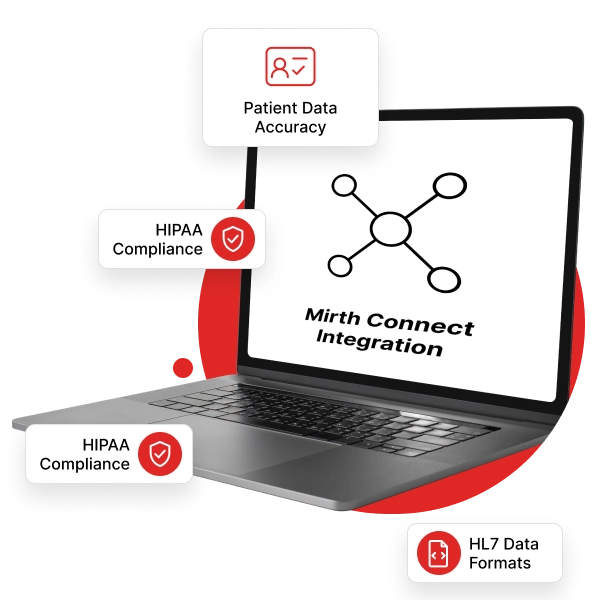
We help US healthcare organizations build secure Mirth Connect environments that support HIPAA focused security practices, internal compliance requirements, and reliable healthcare data exchange
How Our Mirth Connect Engagement Works
Discovery & Interface Assessment
We review your existing systems, message samples, interface specifications, technical requirements, and workflow challenges. For existing channels, we assess the configuration, errors, performance, and documentation.
Architecture & Mapping Design
We define the source and destination systems, message structure, mapping rules, error-handling logic, security controls, and testing requirements. This creates a clear integration specification before development begins.
Mirth Channel Development
Our developers configure connectors, build transformations, create filters, implement validation logic, and develop reusable code templates where needed.
Testing & Validation
We test normal workflows as well as real-world exceptions, including missing fields, duplicate messages, invalid codes, out-of-order events, unavailable destination systems, and unexpected payload structures.
Go-Live & Hypercare
We support production deployment, closely monitor message queues, validate successful data delivery, and resolve priority issues during the post-launch period.
Ongoing Support
After go-live, we provide ongoing Mirth Connect support, monitoring, troubleshooting, enhancements, and interface maintenance based on your operational requirements.
Project Planning & Timelines
A straightforward Mirth Connect channel usually takes 2 to 4 weeks, depending on the requirements, testing, and connected systems. Channel audits and documentation typically take 1 to 3 weeks, while major upgrades and multi channel migrations may take 4 to 12 weeks or longer.
Timelines can vary due to legacy channels, vendor dependencies, test environment availability, and missing documentation. We identify these factors early to keep projects on track and make production cutovers smoother.
Mirth Connect Use Cases We Build Across the US
How Xcodefix Global Solves Mirth Connect Challenges
A US healthcare organization was managing a legacy Mirth Connect environment with undocumented channels, outdated configurations, and limited visibility into interface failures. Xcodefix Global reviewed the existing channels, mapped their dependencies, documented transformation logic, and identified performance and reliability risks.
We then improved error handling and monitoring and created a prioritized plan for channel optimization and version upgrades. This gave the organization better visibility into its integration environment and a clearer path to stable, maintainable Mirth Connect operations.
Why Xcodefix Global for Mirth Connect Development & Support

Healthcare Integration Expertise
We understand the operational realities of healthcare data exchange, including custom HL7 formats, clinical workflows, legacy systems, and strict data-security requirements.

End-to-End Development & Support
From initial channel design to deployment, monitoring, troubleshooting, and long-term maintenance, we support the complete Mirth Connect lifecycle.

Custom Integration Solutions
We do not rely on generic templates alone. Each Mirth Connect solution is configured around your source systems, destination requirements, workflows, and data standards.

Reliable Error Management
We design channels with practical error handling, queue management, acknowledgments, alerts, and retry strategies to improve operational reliability.

Secure & Scalable Architecture
Our Mirth Connect solutions are designed to support secure connectivity, growing message volumes, multiple interfaces, and future interoperability needs.

Flexible Engagement Models
Whether you require a single HL7 interface, a complete integration hub, emergency troubleshooting, or a dedicated long-term support team, we can tailor the engagement to your needs.
Nationwide Mirth Connect Development & Support Services Across the US
We provide Mirth Connect development services, HL7 integration services, FHIR integration services, and healthcare interoperability support for healthcare organizations across the United States.
- Atlanta
- Georgia
- Boston, Massachusetts
- Kansas City, Missouri
- Chicago, Illinois
Need Reliable Mirth Connect Development & Support?
Connect your EHRs, EMRs, laboratories, imaging systems, billing platforms, and healthcare applications with dependable Mirth Connect integration services.
Whether you need a new HL7 interface, FHIR integration, existing channel optimization, urgent error resolution, or ongoing Mirth Connect support, our healthcare integration specialists are ready to help.
Talk to our Mirth Connect experts today and build secure, scalable, and reliable healthcare interoperability workflows with Xcodefix Global.
Get a Free Consultation