
HL7 FHIR Integration in the US | Healthcare Data Integration
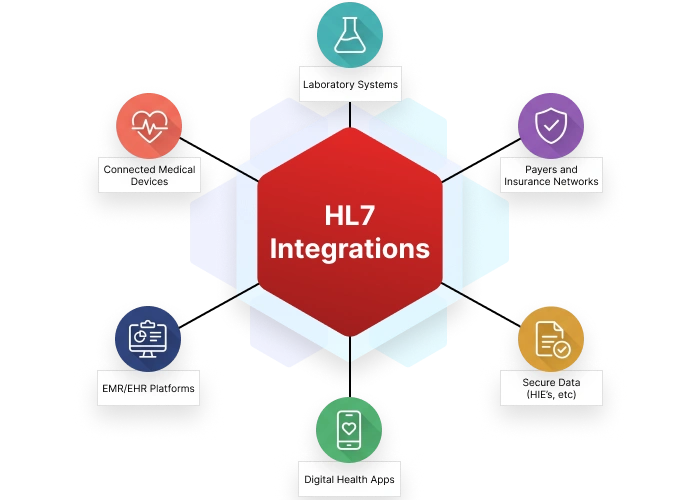
We provide HL7 integration services and FHIR integration services that securely connect EHRs, EMRs, laboratories, payers, medical devices, and digital health applications. Our expertise covers HL7 v2, FHIR R4 APIs, SMART on FHIR, CDA, and Mirth Connect, with HIPAA compliant solutions built for reliable healthcare data exchange.
Why Healthcare Integration Projects Fail & What We Do to Avoid That
Healthcare data integration can seem straightforward at first, but complex healthcare environments create several challenges.
The real challenges begin with the need to:
- Connect EHRs, EMRs, laboratories, imaging systems, payers, pharmacies, and digital health applications
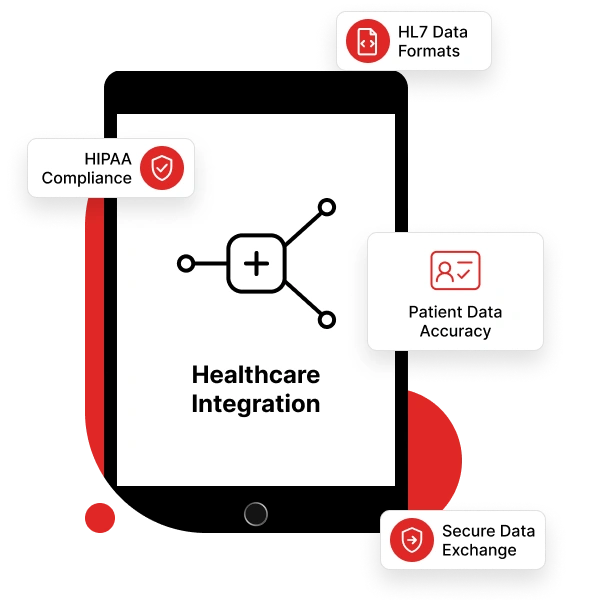
- Handle customized HL7 messages and different data formats
- Integrate systems with limited or evolving FHIR capabilities
- Maintain accurate and consistent patient data
- Meet HIPAA and interoperability requirements
- Keep data exchange secure and reliable
Poor planning can lead to:
- Delayed or failed data exchange
- Fragmented patient information
- Manual and inefficient workflows
- Integration downtime
- Higher maintenance costs
- Security and compliance risks
These problems can become particularly serious for US hospitals, health systems, laboratories, healthcare software vendors, and digital health organizations.
Since 2008, we have delivered HL7 integration, FHIR integration, and healthcare interoperability services across the US. We design secure integration architectures, build reliable HL7 and FHIR workflows, and provide ongoing support.
We connect EHRs, EMRs, laboratories, payers, pharmacies, and healthcare applications for secure, reliable data exchange.
Have more questions?
Contact our support team

HL7, CDA & FHIR Standards for Healthcare Interoperability
Healthcare organizations across the US rely on HL7, CDA, and FHIR to exchange clinical data securely between EHRs, EMRs, laboratories, imaging centers, pharmacies, payers, and healthcare applications. Each standard serves a unique purpose in healthcare interoperability, and understanding how they work together is essential for successful healthcare integration.
HL7 v2
HL7 v2 remains a core messaging standard for US hospitals and health systems. It supports real time clinical data exchange through ADT, ORM, ORU, SIU, DFT, and MDM messages. Because organizations often customize HL7 structures, accurate mapping, validation, profiling, and testing remain essential.
CDA & C-CDA
CDA and C-CDA structure patient information into XML based clinical documents such as discharge summaries, referrals, continuity of care documents, and clinical reports. They support clinical document exchange, health information exchange, and regulatory requirements.
FHIR
FHIR provides a modern API based approach to healthcare interoperability using resources such as Patient, Observation, Encounter, and MedicationRequest. FHIR R4 supports US interoperability initiatives, EHR integration, patient applications, healthcare analytics, and digital health platforms through REST APIs using JSON or XML.
HL7 v2.x vs FHIR R4
Most US healthcare organizations use both standards. HL7 v2 continues to support internal clinical workflows, while FHIR enables secure data sharing with modern healthcare applications. Building a reliable bridge between HL7 and FHIR is essential for successful healthcare interoperability, EHR integration, and healthcare API integration.
HL7 & FHIR Integration Services for US Hospitals & Labs
Whether you need a single laboratory interface or a complete healthcare interoperability platform, our team delivers scalable healthcare integration services in the USA for new implementations, legacy system modernization, and complex integration projects. We also help organizations recover and optimize existing healthcare integrations that require performance improvements, modernization, or long term operational support.
Terminology Services: SNOMED CT, LOINC, and ICD
Interfaces move data; terminology makes it mean something. A result message is only useful if the receiving system knows that the sender's local code K_2 is serum potassium. We build terminology mapping into every pipeline:
LOINC for laboratory tests and observations (including the unglamorous work of mapping legacy local lab compendia).
SNOMED CT for clinical findings, procedures, and problem lists.
ICD-10 / ICD-11 for diagnoses and billing workflows, with attention to national modifications and US claims processing.
RxNorm and local drug dictionaries for medication data where the use case requires it.
Mappings live in versioned, reviewable tables, not buried in transformation code, so clinical reviewers can validate them and audits can trace every translation decision.
Security Architecture for Mirth Connect
Mirth Connect interfaces can process sensitive clinical data, so security must cover every point where data enters, moves through, and leaves the integration environment. Xcodefix Global builds security into the Mirth Connect architecture from the start.
Our approach includes:
OAuth 2.0 and SMART on FHIR for secure FHIR API access
TLS and mutual TLS for encrypted healthcare data exchange
Access controls with least privilege and appropriate permissions
Audit logging for interface activity and administrative access
Data minimization to limit unnecessary PHI within messages and payloads
Boundary validation to identify and quarantine malformed data
Secure credential management for APIs, databases, and connected systems
We also support secure Mirth Connect deployments on client managed infrastructure or monitored cloud environments.
Compliance for Mirth Connect Integrations
Mirth Connect environments that process PHI need to support the organization's healthcare compliance requirements. Xcodefix Global helps US healthcare organizations align their integration environments with applicable security and interoperability requirements.
Our approach supports:
HIPAA and HITECH requirements for protecting PHI
ONC 21st Century Cures Act interoperability considerations
Documented data flows across connected healthcare systems
Enforced access controls and audit trails
Security and incident response procedures
BAA requirements where our services involve access to PHI
We help organizations connect their Mirth Connect security controls with their broader compliance program, so technical safeguards and compliance processes work together.
How an Integration Engagement Runs
Discovery and Message Profiling
We inventory the systems, obtain real (de-identified where required) message samples and API capability statements, and document what each side actually produces, rather than what its manual claims. Output: an interface specification both sides sign off on.
Architecture and Mapping Design
Engine selection, transformation design, terminology mapping tables, error-handling strategy, and the FHIR resource/profile design where applicable. Security architecture is fixed here, not retrofitted.
Build and Iterative Testing
Interfaces built against recorded real-world messages, with unit-tested transformations. We test the ugly cases: missing segments, encoding oddities, out-of-order events, and duplicate identifiers.
Integrated Testing and Validation
End-to-end runs with the counterpart system's test environment, clinical review of mapped data, load testing at realistic peak volumes, and a documented cutover plan with rollback.
Go-Live and Hypercare
Monitored cutover with engineers watching queues in real time, followed by a defined hypercare window with accelerated response before transitioning to steady-state support.
Ongoing Monitoring and Support
Queue depth, error-rate, and liveness monitoring with alerting, plus SLA-backed support.
Timelines and Project Realities
A single well-defined v2 interface typically lands in 2 to 6 weeks. A FHIR façade over a legacy system is usually a 2 to 4 month effort. Multi-system programmes run longer, and we will tell you so up front. The main schedule risk is rarely our build, but rather counterpart-vendor responsiveness, which is why our process front-loads those dependencies.
HL7 & FHIR Integration Use Cases for US Healthcare
A Real World HL7 & FHIR Integration Example
A multi-site diagnostic laboratory needed a better way to deliver test results to multiple clinics using different EMR systems. We replaced their manual courier and PDF process with a secure integration solution. Our team analyzed the laboratory information system (LIS), built a Mirth Connect integration hub, mapped local test codes to LOINC, and delivered HL7 v2 ORU interfaces and secure FHIR DiagnosticReport APIs based on each clinic's requirements.
During testing, we identified issues that could have affected patient care. One EMR rejected records with hyphens in patient IDs, while another accepted messages but failed to save them. Our validation and monitoring process detected these problems before going live, ensuring reliable and accurate clinical data exchange across all connected systems.
Why Xcodefix Global for HL7 & FHIR Integration Services

Healthcare Integration Expertise
Since 2008, we have delivered trusted HL7, FHIR, and healthcare interoperability solutions for US hospitals, labs, and digital health organizations.

Proven Standards Expertise
Our experts deliver secure HL7, FHIR, SMART on FHIR, and Mirth Connect solutions that integrate seamlessly with real world healthcare systems.

Built with Security & Compliance
Every integration follows HIPAA, ISO 27001, and SOC 2 best practices to protect patient data and support healthcare compliance.

Complete Healthcare Technology Solutions
From healthcare API integration to cloud infrastructure and custom software, we deliver complete solutions with one experienced team.

Scalable & Future Ready Solutions
We build scalable HL7 and FHIR integration solutions that adapt to changing healthcare standards, growing data volumes, and future technology needs.

End to End Implementation & Support
We design, deploy, monitor, and support healthcare integrations with proactive maintenance and SLA backed support for reliable performance.
Nationwide HL7 & FHIR Integration Services Across the US
We provide HL7 integration services, FHIR integration services, and healthcare interoperability solutions for hospitals, health systems, laboratories, healthcare software vendors, digital health companies, and payers across the United States.
- California
- Texas
- Florida
- New York
- Illinois
- Pennsylvania
- Ohio
- Georgia
- North Carolina
- Washington
- Virginia
- Massachusetts
- Arizona
- Colorado
- Michigan
- Minnesota
- New Jersey
- Tennessee
- Maryland
Ready to Modernize Your Healthcare Integration?
Connect your EHRs, EMRs, laboratories, and healthcare applications with secure HL7 integration services, FHIR integration services, and healthcare interoperability solutions. Whether you need a new integration, legacy system modernization, or ongoing support, our team is ready to help
Talk to our healthcare integration experts today and build a secure, scalable, and HIPAA compliant interoperability solution with XCodefix Global.
Get a Free Consultation