
HR Management Software for Growing Teams
Most HR software is bought to solve one problem and then quietly abandoned because nobody opens it. Ours is built around a simpler test: does the whole company use it without being chased? Everything from hiring to the final settlement sits in one portal, and the spreadsheets underneath it disappear.
Why HR Systems Get Abandoned
Companies rarely choose spreadsheets for HR. They end up there because the alternative was worse, and the reasons are consistent:
- The system was configured for a company that does not resemble yours
- Employees never log in, so managers chase them by email anyway
- Payroll is calculated somewhere else and reconciled by hand
- Leave balances are argued about because nobody trusts the number
- Implementation needed a consultant and never really finished
- Half the modules were bought and none of them were adopted
The cost is rarely a line in a budget, which is precisely why it persists for years:
- HR spends its week chasing approvals rather than doing HR
- Payroll corrections are discovered after the money has moved
- Nobody can answer a simple question without opening three files
- Statutory records are assembled retrospectively under pressure
- New joiners form their first impression from a chaotic first week
- Departures leave loose ends that surface months later
Xcodefix Global built this HR platform for growing companies that have outgrown spreadsheets but have no appetite for a twelve-month implementation project. It covers the work HR does every week rather than offering a catalogue of modules nobody switches on.
The design principle is adoption. If employees and managers do not open the portal, HR ends up doing their work for them and the software has failed regardless of its feature list. Everything is arranged around that reality.
Want to see it on your own data?
We run walkthroughs against a real scenario, not a canned slide deck. Contact Xcodefix Global to arrange one.

How the Platform Is Organised
One Record
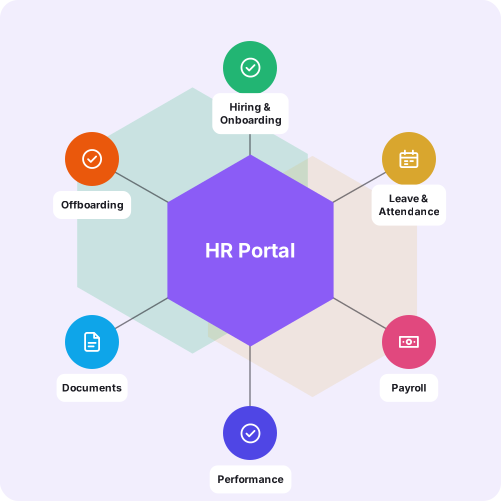
Every employee has a single record that hiring, payroll, leave, attendance and documents all read from, which removes the reconciliation work that separate systems create.
Self-Serve by Default
Employees and managers handle their own requests, approvals and documents, so HR stops being the routing layer for routine administration.
Traceable Decisions
Approvals, corrections and changes leave a trail, so questions months later are answered from the record rather than from memory.
What the Platform Covers
Which Companies This Suits
Companies Outgrowing Spreadsheets
Somewhere between thirty and a couple of hundred people, spreadsheet-based HR stops being pragmatic and starts being a risk. That transition is precisely what this platform is built for.
Teams Without a Large HR Function
Where one or two people carry HR alongside other duties, the deciding factor is how much administration the system removes rather than how many modules it offers.
Businesses That Cannot Stop for a Project
Companies unwilling to commit to a long implementation need something that can be started quickly and extended later, rather than a programme that consumes a quarter.
How We Get You Running
Understand How You Work
We look at your existing policies and the way HR actually operates today, because configuring the system around a real process is what determines whether people use it.
Set Up Your Portal
Your branded portal is created and the core employee records are established, so there is something real to work with from the outset.
Configure Policies
Leave, attendance and statutory rules are configured to match your obligations rather than to a default that fits nobody exactly.
Bring the Team In
Employees and managers are introduced to the portal with a short session focused on the few things they will do regularly.
Extend Over Time
Additional areas are brought in once the basics are embedded, which is far more reliable than switching everything on at once and hoping for adoption.
Why Companies Choose Our HR Platform

Built for Adoption
A portal people actually open is worth more than a comprehensive one they avoid. Everything is arranged so that routine tasks are quicker in the system than outside it.

One System, Not Six
Hiring, leave, attendance, payroll and records read from the same employee record, which is what removes the monthly reconciliation work.

Configurable Statutory Rules
Rules differ by company and jurisdiction. They are configurable rather than fixed, so the system fits your obligations instead of the other way round.

Separated by Construction
Each company’s data is separated by design, and access is scoped by role so people see what their job requires and no more.

Live in Days, Not Quarters
The platform is designed to be started without an implementation project, which is usually the difference between rolling it out and postponing it indefinitely.

Supported by Our Engineers
It is built and maintained by an established IT company, with named people to talk to rather than a queue to join.
HR Software for Companies Across the United States
We work with growing companies across the US, including IT services firms, healthcare organisations and professional services businesses that need HR administration to stop consuming their week.
- Atlanta, Georgia
- Boston, Massachusetts
- Chicago, Illinois
- Dallas, Texas
- San Jose, California
See Whether Your Team Would Actually Use It
The honest test of HR software is not its feature list. It is whether employees open it without being reminded, and whether HR gets its week back.
We run demonstrations against a realistic scenario, including the parts most vendors skip, so you can judge adoption rather than take it on trust.
Contact Xcodefix Global to arrange a walkthrough for your team.
Request a Demo