
Payroll Management Software That Shows Its Working
Payroll goes wrong quietly and is discovered loudly. The usual cause is not arithmetic but disconnection: attendance lives in one place, leave in another, and payroll is assembled from both by hand under time pressure. Ours calculates from the same records those numbers already live in.
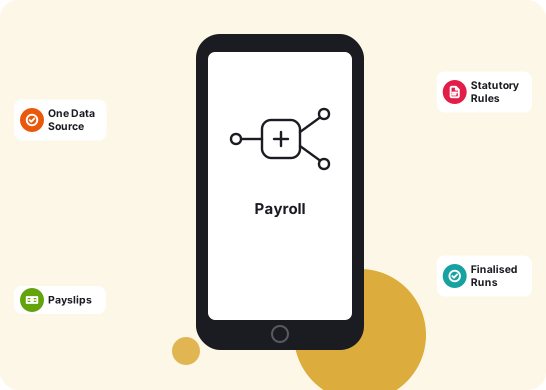
Where Payroll Processes Break Down
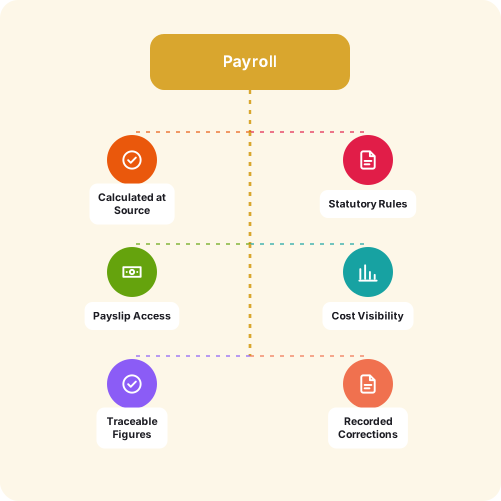
Payroll is rarely difficult in principle. It becomes difficult because of how the inputs arrive:
- Attendance is exported from one system and leave from another
- Adjustments are applied by hand and remembered by one person
- Nobody can explain a figure without rebuilding the calculation
- Corrections are found after the payment has already gone out
- Statutory rules are applied from memory or from an old note
- The same reconciliation is repeated from scratch every month
The visible errors are only part of the cost, and usually not the largest part:
- Senior time is consumed by an exercise that repeats monthly
- Employees lose confidence in figures they cannot have explained
- Corrections create their own downstream reconciliation work
- Audit preparation becomes an archaeology project
- The process depends on one person who cannot take leave
- Nobody has capacity to question whether the rules are still right
Payroll in the Xcodefix Global HR platform is built on the same employee records that hold attendance, leave and employment terms. That removes the export-and-reconcile cycle that produces most payroll errors in growing companies.
Just as importantly, calculations are traceable. When an employee questions a figure, the answer comes from the system rather than from somebody rebuilding the sum in a spreadsheet and hoping it matches.
Want to see it on your own data?
We run walkthroughs against a real scenario, not a canned slide deck. Contact Xcodefix Global to arrange one.

How Payroll Is Structured
Calculated From Source
Payroll reads the attendance and leave records directly rather than importing a summary of them, which is where discrepancies usually enter.
Rules You Configure
Statutory and company rules are entered once and applied consistently, so treatment does not depend on who happened to run payroll that month.
Finalised as a Record
A completed run is a record rather than a working draft, which is what makes later questions answerable and audits straightforward.
What Payroll Covers
Where Connected Payroll Matters Most
Companies Reconciling Every Month
If payroll begins by exporting attendance and leave from elsewhere, the errors are structural. Calculating from the same records removes the cause rather than improving the checking.
Businesses With Variable Pay
Where pay depends on attendance, overtime or leave treatment, the connection between those records and the calculation is not a convenience. It is the difference between accuracy and approximation.
Teams Facing Audit Scrutiny
Organisations that have to evidence how a figure was reached need finalised runs to be records with a trail, not spreadsheets that were correct at the time.
How Payroll Is Brought Across
Review the Current Process
We look at how payroll is produced today, including the manual adjustments that rarely appear in any documentation but always affect the result.
Configure the Rules
Statutory and company rules are entered and confirmed, so the treatment applied is the treatment that genuinely applies to your business.
Run in Parallel
An early cycle is run alongside your existing process so that differences surface before anything depends on the new system.
Resolve the Differences
Any discrepancies are traced back to the rule or record behind them, which frequently uncovers inconsistencies in the previous process as well.
Go Live
Once a cycle reconciles cleanly, payroll runs from the platform, with our team available during the first live cycles when deadlines are least forgiving.
Why Finance and HR Teams Rely on It

Every Figure Is Traceable
A payroll number you cannot explain is a problem waiting to surface. Calculations trace back to the rule and the record behind them.

No Monthly Reconciliation
Because payroll reads from the same records as attendance and leave, the reconciliation exercise that consumes the first week of the month largely disappears.

Rules Configured to Your Obligations
Statutory treatment differs by company and jurisdiction, so the rules are yours to configure rather than assumptions baked into the product.

Payroll-Grade Access Control
Payroll data is among the most sensitive a company holds. Access is scoped by role, and the platform is built by a firm whose core work is security.

A Record, Not a Draft
Finalised runs are records. That distinction is what makes audits, disputes and year-end straightforward rather than stressful.

Help When Cycles Get Tight
Payroll has deadlines that do not move. You have named engineers to reach rather than a ticket queue to wait in.
Payroll Software for Companies Across the US
We work with growing companies across the United States that need payroll to stop being a monthly reconstruction exercise, particularly IT services, healthcare and professional services firms.
- Atlanta, Georgia
- Boston, Massachusetts
- Chicago, Illinois
- Dallas, Texas
- San Jose, California
Make Payroll Explainable Again
If running payroll begins with exporting data from two systems, the errors are structural rather than careless, and no amount of care will remove them.
We will show you how a run is calculated, reviewed and finalised, using a scenario close to how your own payroll works.
Contact Xcodefix Global to arrange a demonstration.
Request a Demo